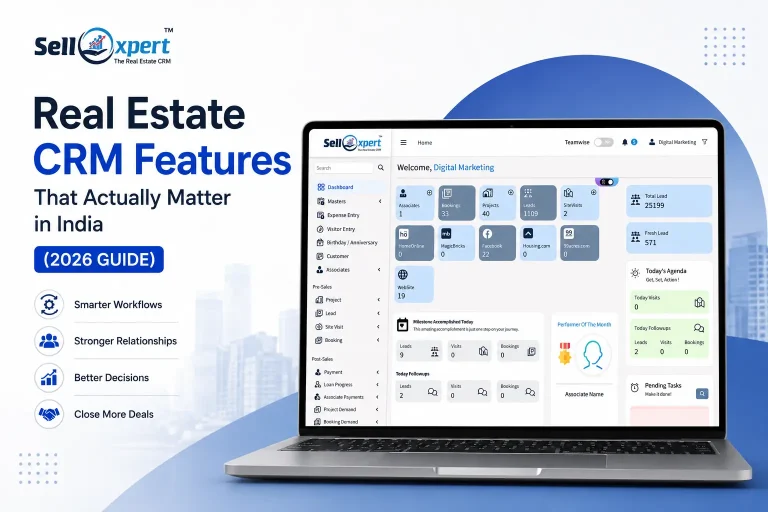
Search “best real estate CRM” and you’ll find dozens of posts recycling the same US-style checklist — IDX websites, MLS sync, email drip campaigns. None of that reflects how property actually gets sold in India. Here, deals move through WhatsApp, cost sheets with a dozen pricing components, and tier-2 city phone calls, not IDX widgets.
With Indian real estate racing toward a trillion-dollar market and over 535 million WhatsApp users driving buyer conversations, the CRM question for builders, brokers, and agents in 2026 isn’t “should I get one” — it’s “which features stop leads from leaking through the cracks I already know exist.”
Here’s what genuinely matters, and the questions to ask before you sign a contract.
1. Native WhatsApp Business API — Not Just a “WhatsApp Integration” Badge
This is the single biggest differentiator in the Indian market, full stop. Over 70% of initial buyer communication in Indian real estate happens on WhatsApp — property queries, brochure requests, site-visit confirmations, payment reminders. A CRM without native WhatsApp means your agents are toggling between two apps and losing deals in the gap.
But “WhatsApp integration” means different things across vendors. Some platforms only show a WhatsApp timeline (read-only history) rather than a full chat inbox. Others route messages through a third-party BSP (Business Solution Provider) like Twilio or Interakt, which adds ₹1,500–₹5,000/month in extra cost and an external dependency you didn’t budget for.
2. Cost Sheet Generation With Indian Pricing Components
A US-style “list price” doesn’t exist in Indian real estate — actual pricing is built from a stack of components: base rate, floor rise charge (PLC), preferential location charge, parking, club membership, GST, and stamp duty, all varying by project and sometimes by unit. A generic CRM has no concept of this and forces your sales team back into Excel every time a buyer asks “what’s my final number.”
A CRM built for the Indian market should generate an itemized cost sheet automatically — pulling unit-specific components and taxes into a document a buyer can actually understand — instead of your team manually recalculating it in a spreadsheet for every enquiry.
3. Lead Capture From Indian Portals, Not Just “Integrations”
Your leads aren’t coming from IDX websites — they’re coming from 99acres, MagicBricks, Housing.com, NoBroker, Facebook Lead Ads, and increasingly Instagram, often 500+ a month for a mid-sized developer. Without a CRM pulling all of this into one inbox, that volume scatters across spreadsheets, personal WhatsApp chats, and email threads — and studies suggest 30-40% of portal leads simply never get contacted.
Just as important in tier-2 and tier-3 markets: many buyers still prefer to call rather than fill a form. A missed-call alert system or IVR integration that automatically logs phone inquiries and triggers a callback is not a nice-to-have outside metro markets — it’s often the primary lead source.
4. AI Lead Scoring Calibrated for Indian Buyer Behaviour
Indian property portals generate a mix of genuine buyers, price-checkers, and casual browsers — high volume, low intent-differentiation. Generic lead scoring (built for SaaS or e-commerce) doesn’t map well here. What you actually want is scoring that weighs property budget, BHK preference, and possession timeline — the factors that separate a real buyer from someone comparing five projects for fun.
Some platforms now go further with AI call analysis that extracts a caller’s budget and BHK preference automatically from the conversation itself, with multi-language transcription across several Indian languages — genuinely useful in a market where a single sales team might field calls in Hindi, English, and a regional language in the same hour.
5. Inventory Management by Unit — Not Just Deal Stages
Real estate isn’t a single SKU. A CRM needs to track availability, pricing, and status at the level of tower, floor, and unit — BHK configuration, facing, carpet area, hold/booked/registered status — and ideally match buyer preferences to available inventory automatically rather than making your sales team cross-check a spreadsheet mid-call.
For developers, this should extend beyond booking into milestone-based payment schedules, automated demand letters, and construction-stage updates pushed to buyers — the entire lead-to-possession lifecycle, not just pre-sales.
6. Channel Partner (CP) Management
Most Indian developers sell through dozens of brokers, not direct sales alone. If your CRM can’t give channel partners real-time inventory visibility, commission tracking, and deal transparency through their own login, you’ll end up managing CP relationships over WhatsApp groups and Excel — exactly the fragmentation a CRM is supposed to fix.
7. Regional Language Support and NRI Buyer Handling
A single sales team in India often fields calls in Hindi, English, and a regional language within the same hour — and call transcription or AI summaries that only work in English miss most of what actually gets said on the floor. Multi-language transcription and communication support isn’t a luxury feature here; it’s what makes the CRM usable for the people actually answering phones.
Separately, NRI buyers are a meaningful share of the market for many developers and premium brokerages, and they bring their own requirements: communication across time zones, virtual site-visit scheduling, and payment/document workflows that don’t assume the buyer is physically in the country. A CRM that only assumes a domestic, walk-in buyer journey will fall short here.
Matching the CRM to Who You Actually Are
Most “top 10” lists treat a solo broker in Jaipur and a 200-crore developer in Pune as the same buyer. They aren’t:
- Solo agent / small broker: Prioritize WhatsApp inbox and lead capture over inventory or CP modules you don’t need yet.
- Telecalling-heavy team: Prioritize dialer + IVR + WhatsApp combo — calling automation matters more than marketing polish.
- Mid-size agency (5–50 agents): Prioritize full-lifecycle coverage (lead to possession) and transparent per-user pricing over brand-name recognition.
- Large developer / multi-project builder: Prioritize inventory grids, cost sheet automation, and CP management — a generic CRM plus five bolt-ons will cost more and do less than a real-estate-native platform.
The Contract Trap: What Gets Locked In Before You Read the Fine Print
Most Indian real estate CRM buyers evaluate cost by comparing the monthly quote across vendors. That’s the wrong comparison. The real cost trap isn’t the sticker price — it’s the contract structure around it, and three things quietly decide what you actually pay over a year:
Annual lock-in with no mid-term exit. Most vendors quote monthly pricing on the sales call but only offer annual billing at signup, often with a discount that disappears if you try to leave early. If your team size or lead volume changes in month four, you’re stuck paying for capacity you no longer need until renewal.
Per-agent pricing that punishes growth. A quote based on your team of 8 today looks very different at 20. Ask specifically what happens to per-seat cost as you scale — some vendors tier pricing so aggressively that doubling your team more than doubles your bill, right when you can least afford surprises. Want to know how pricing works? Book a call with our expert.
The Bottom Line
In India, a real estate CRM isn’t judged by how many features it lists — it’s judged by whether it thinks in WhatsApp, rupees, and cost sheets, or whether it’s a generic tool wearing a real estate mask. Ask the harder questions above before you compare price sheets. That’s where the real decision gets made.
To get expert guidance on features before finalizing a real estate CRM, talk to our expert today.

