
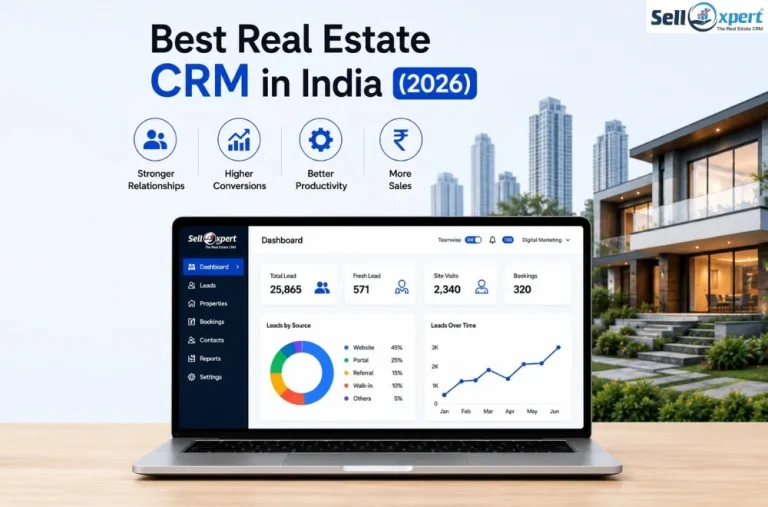
Real estate CRM in India has gone from a nice-to-have to the single biggest lever in your sales process.
India’s real estate market is headed to $1 trillion by 2030 — yet most developers still lose 60–70% of their leads to poor follow-up and manual processes.
In this guide, we cover everything: types of real estate CRM available in India, features that actually matter for the Indian market, a comparison of the top 7 tools, and a clear decision framework to help you choose the right one.
Quick Answer — Best Real Estate CRM in India (2026)
The top real estate CRMs for the Indian market are:
- Sellxpert — Best for builders & developers (end-to-end)
- Zoho CRM — Best for brokers & agencies needing flexibility
- LeadSquared — Best for high-volume lead management
Scroll down for a full breakdown with pricing, features, and verdict.
Why Indian Real Estate Needs a Different CRM
The Indian real estate market operates differently from Western markets — and generic CRMs built for those markets often miss the mark. Here’s what the numbers tell us:
- India’s real estate sector contributes approximately 7.3% of GDP and is expected to grow to $1 trillion by 2030 (Source: CREDAI-KPMG)
- As of 2025, over 1.2 lakh projects are registered under RERA across India, each with compliance obligations your CRM must support
- More than 70% of real estate leads in India come from digital sources — Facebook, 99acres, MagicBricks, and WhatsApp — meaning your CRM must integrate with these platforms natively
- Lead-to-site-visit conversion rates in Tier-1 cities average 8–12%, compared to 18–25% in Tier-2 cities — follow-up speed is the biggest differentiator (Source: NoBroker Industry Report, 2024)
- Developers using CRM-driven follow-up workflows report 30–40% improvement in site visit conversion rates within 3 months of adoption
You need a CRM that understands local market and have features like lead management, inventory management, site visit management , channel partner management, and back office work flow.
Types of Real Estate CRM in India
The Indian market offers several categories of CRM, each suited to different business types. Here’s a practical breakdown:
1. Cloud-Based CRM
Best for: Startups, SMEs, and distributed sales teams who need access from anywhere.
Cloud CRMs are hosted online and accessible via browser or mobile app. They require no server infrastructure, have low upfront costs, and update automatically. For real estate teams spread across multiple sites or cities, this is the most practical choice. Examples: Sellxpert, Zoho CRM.
2. On-Premise CRM
Best for: Large developers with dedicated IT teams and strict data security requirements.
Installed on your own servers, giving you full control over data. Higher maintenance cost and setup time, but preferred by organisations handling large volumes of sensitive buyer data. Examples: Microsoft Dynamics 365, SAP Real Estate Management.
3. Vertical-Specific Real Estate CRM
Best for: Developers and builders who need purpose-built workflows.
These CRMs are designed specifically for real estate — not adapted from generic sales tools. They include features like inventory management for under-construction and ready-to-move units, RERA compliance tracking, site visit scheduling, and pre-sales to post-sales pipeline management. Sellxpert is a leading example in this category in India.
4. AI-Powered CRM
Best for: Metro-market developers and tech-forward agencies.
AI-powered CRMs use machine learning to score leads by conversion likelihood, automate follow-up management, and predict the best time to contact a prospect. Growing rapidly in Tier-1 markets like Mumbai, Bengaluru, and Hyderabad. Examples: Sellxpert (AI lead scoring), Zoho CRM with Zia AI.
5. Brokerage-Focused CRM
Best for: Individual agents, small brokerages, and channel partner networks.
Lightweight and mobile-first, with commission tracking and quick lead assignment. Examples: LeadSquared, Engagebay.
6. Open-Source CRM
Best for: Tech teams who want deep customisation and have developer resources.
Free to use and modify, but requires IT expertise to deploy, maintain, and integrate. Examples: SuiteCRM. Not recommended for teams without a dedicated technical team.
How to Choose the Right Real Estate CRM in India
Use this decision framework to narrow down your options before evaluating vendors:
| Your Business Type | Primary Need | Recommended CRM Type | Top Picks |
| Builder / Developer | Inventory management, RERA compliance, pre-to-post sales pipeline | Vertical-specific / AI-powered | Sellxpert, DaeBuild |
| Broker / Agency | Lead management, multi-portal integration, team tracking | Cloud-based / Brokerage-focused | Zoho CRM, LeadSquared |
| Solo Agent | Simple pipeline, WhatsApp follow-up, mobile access | Cloud-based (light plan) | Freshsales, Engagebay |
| Large Enterprise | Data security, multi-city operations, custom workflows | On-premise or Enterprise Cloud | Sellxpert Enterprise, Microsoft Dynamics |
| Marketing Agency | Lead source tracking, client reporting, channel partner management | Cloud-based with API integrations | Sellxpert, Cratio CRM |
Three quick questions to ask any CRM vendor before signing up:
- Does it integrate natively with 99acres, MagicBricks, and Facebook Lead Ads — or do I need a third-party tool?
- Do they provide comprehensive training and after sale support?
- Is there WhatsApp Business API integration for follow-up automation?
If the answer to any of these is “no” or “with a workaround,” keep looking.
Key Features to Look for in a Real Estate CRM in India
1. Lead Management & Source Tracking
Your CRM must capture leads automatically from all Indian portals — 99acres, MagicBricks, Housing.com, Facebook, and WhatsApp — and attribute them to the right source. Manual lead entry kills speed-to-contact, and in Indian real estate, the first 5 minutes after a lead comes in are critical. Look for automated lead capture with source attribution and instant assignment rules.
2. Site Visit Management
Site visit scheduling and tracking is one of the most India-specific CRM needs. You need to be able to assign site visits to sales executives, track show-up rates, send automated reminders via WhatsApp or SMS, and log post-visit feedback — all in one place.
3. Inventory Management
Managing unit-level inventory — across towers, floors, and configurations — is a non-negotiable for builders. Your CRM should show real-time availability, allow blocking and releasing of units, and integrate with your booking process. See how CRM inventory management reduces booking errors and double-allotments.
4. Channel Partner (CP) Management
Channel partners drive a significant portion of residential sales in India, especially in metros. Your CRM should have a dedicated CP portal or module — tracking which broker referred which lead, what commission is due, and ensuring transparent payouts. This also protects you from lead duplication disputes.
5. RERA Compliance Features
With over 1.2 lakh RERA-registered projects in India, compliance is not optional. A good CRM should help you maintain project-wise documentation, generate reports aligned with RERA requirements, and flag delays or deviations that could result in penalties.
6. WhatsApp integration
WhatsApp is India’s primary communication channel for buyer follow-up. Your CRM should integrate with WhatsApp Business API to send automated follow-ups, property brochures, and payment reminders.
7. Financial Tracking & Demand Letter Generation
For developers, the CRM should handle payment milestone tracking, demand letter generation, and receipts — reducing the back-and-forth between sales, accounts, and customers.
Top 7 Real Estate CRM Software in India (2026)
| CRM | Best For | India-Specific Features | Pricing | Verdict |
| Sellxpert | Builders, developers, real estate firms of all sizes | RERA compliance, CP management, site visit tracking, inventory management, WhatsApp integration, demand letters | Custom pricing (contact for quote) | Best overall for Indian developers & builders |
| Zoho CRM | Brokers, agencies, multi-industry teams | 99acres/MagicBricks integration via Zoho Marketplace, multi-language UI, INR billing | ₹1,300–₹2,600/user/month | Best for brokers who need flexibility and already use Zoho suite |
| LeadSquared | High-volume lead management, brokerages | Deep portal integrations, SMS & WhatsApp automation, field sales app | ₹2,500–₹5,000/user/month | Best for agencies managing 500+ leads/month across multiple projects |
| DaeBuild CRM | Real estate developers in Gujarat | Project-specific inventory management, RERA-aligned reporting, local market workflow | Contact vendor | Strong niche pick for Gujarat-based developers; limited outside that geography |
| Cratio Real Estate CRM | Agents, brokers & developers in South India | SMS & email campaign automation, lead scoring, project tracking, South India portal integrations | ₹1,000–₹2,000/user/month | Good for Chennai/Bangalore brokers; feature set more limited for developers |
| Engagebay | Solo agents, small brokerages on a tight budget | Email & SMS automation, lead scoring, basic pipeline management; INR pricing available | Free plan available; paid from ~₹800
/user/month |
Best entry-level option for solo agents or small teams not ready for a full real estate CRM |
| Field Proxy | Teams with field sales / property inspection staff | GPS tracking for field agents, attendance management, site visit check-in/check-out | Contact vendor | Specialist tool for field force management; pair with a full CRM for complete coverage |
How to Implement a Real Estate CRM in Your Business
A CRM is only as good as its adoption. Here’s a practical 6-step rollout plan that works for Indian real estate teams:
1. Audit your current process first. Map where leads come from, how they’re currently tracked, and where they’re falling through the cracks. This tells you which CRM features matter most for your business.
2. Shortlist and demo 2–3 tools. Don’t evaluate more than three at a time. Focus your demo on your top pain points — site visit follow-up, lead duplication, or inventory errors. Ask vendors to show you, not just tell you.
3. Migrate clean data. Before going live, clean your existing lead database. Duplicate contacts and outdated records will corrupt your new system from day one.
4. Configure integrations before training. Get your portal integrations (99acres, MagicBricks, Facebook) live before you train the team. If leads aren’t flowing in automatically on day one, adoption drops fast.
5. Train in phases. Start with your sales managers, then roll out to the full team. Use your CRM vendor’s onboarding support — most reputable vendors offer dedicated onboarding for Indian clients.
6. Review weekly for the first 60 days. Track lead response time, site visit conversion rate, and pipeline velocity weekly. Most teams see measurable improvement in 30–45 days when they’re consistent.
Overcoming Common Real Estate CRM Implementation Challenges
Team resistance: The most common failure point. The fix is not motivation — it’s making the CRM easier than the alternative. If the CRM is faster than WhatsApp groups for lead updates, your team will use it. Involve your top-performing sales executive in the selection process; their buy-in cascades down.
Data quality issues: Indian real estate businesses often have years of leads spread across Excel sheets, WhatsApp, and email. Don’t try to migrate everything. Import only the last 6–12 months of active leads and let older data sit in an archive.
Integration gaps: Some CRMs claim to “integrate” with Indian portals but require manual CSV exports. Push vendors on this specifically — ask them to demonstrate a live lead coming in from 99acres or Facebook during the demo.
Cost concerns: Indian real estate teams often underestimate the ROI of CRM adoption. If your CRM helps your team convert just 2–3 additional site visits per month, it pays for itself. Calculate this before negotiating on price.
If you want to get personalized guidance about real estate CRM selection, adoption and best practices – book a call with our experts.
Frequently Asked Questions — Real Estate CRM in India
What is the best real estate CRM in India?
The best real estate CRM in India depends on your business type. For builders and developers, Sellxpert is the top choice because it’s purpose-built for the Indian market with features like lead management, inventory management, marketing integration, channel partner tracking, IVR and WhatsApp integration. For brokers and agencies managing high lead volumes, LeadSquared and Zoho CRM are strong alternatives. There is no single “best” tool — the best CRM is the one that fits your sales process and scales with your team.
Regardless of the numerous choices, Sellxperts stands out because of its simple UI, on-site training & amazing after sales support team.
Which CRM is used by builders in India?
Most professional real estate builders in India use vertical-specific CRMs — tools designed specifically for real estate rather than adapted from generic sales software. Sellxpert is widely used by builders and developers across India for its pre-sales, sales, and post-sales pipeline management.
DaeBuild is popular among Gujarat-based developers. Larger enterprise builders sometimes use Zoho CRM or LeadSquared due to their flexibility and large support ecosystems.
Is Zoho CRM good for real estate in India?
Zoho CRM is a solid choice for brokers and agencies in India, especially if you already use other Zoho products (Zoho Books, Zoho Desk, etc.). It integrates with Indian property portals through third-party connectors, supports INR billing, and has a large partner ecosystem in India for customisation.
However, it lacks native real estate features like inventory management, site visit management, channel partner management, EMI management & post sales workflows.
For builders and developers, a vertical-specific CRM like Sellxpert will require less customisation and deliver faster results.
What features should a real estate CRM have for the Indian market?
A real estate CRM built for India must have: (1) native integration with 99acres, MagicBricks, Housing.com, and Facebook Lead Ads; (2) WhatsApp Business API integration for follow-up automation; (3) Lead management; (4) site visit scheduling and tracking; (5) inventory management for unit-level availability; (6) channel partner management with commission tracking; and (7) Site visit management
How much does a real estate CRM cost in India?
Real estate CRM pricing in India varies widely. Budget tools like Engagebay start at around ₹800/user/month. Mid-range options like Zoho CRM cost ₹1,300–₹2,600/user/month. Specialist platforms like LeadSquared can go up to ₹5,000/user/month.
Vertical-specific CRMs like Sellxpert offer custom pricing based on team size and feature requirements. Most vendors offer annual billing discounts of 15–20%.
Can a real estate CRM integrate with WhatsApp in India?
Yes — most modern real estate CRMs in India either have native WhatsApp Business API integration or connect via third-party platforms like Wati, Interakt, or AI-sensy. This allows you to send automated follow-ups, share property brochures, confirm site visit appointments, and send payment reminders directly through WhatsApp. Given that WhatsApp has over 500 million users in India, this integration is now a baseline requirement rather than a premium feature.
How long does it take to implement a real estate CRM in India?
For a small team (5–15 users) with clean data and a vendor that provides onboarding support, a real estate CRM can be live and functional within 2–4 weeks. Larger teams with complex workflows, multiple project sites, and extensive data migration can take 6–12 weeks. The biggest variable is data quality — teams that invest a week in cleaning their lead database before migration see significantly smoother rollouts.
Ready to see how Sellxpert works for your real estate business?
Sellxpert powers 500+ real estate sales teams across India — builders, developers, brokers, and marketing agencies. Book a free 30-minute consultation with our team to see if it’s the right fit for your business.