
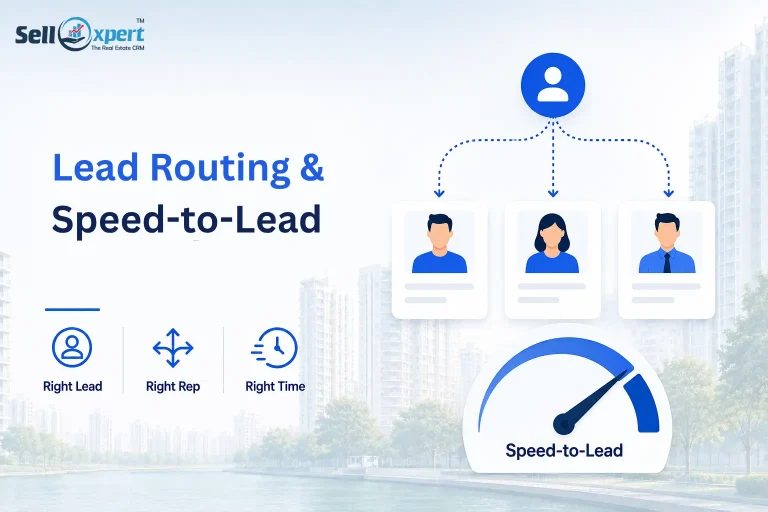
Walk into any high-performing real estate sales floor in Gurugram, Pune, or Bengaluru, and you’ll notice something that has nothing to do with the projects they’re selling. It’s the system running quietly in the background — the one that decides which sales executive gets which lead, and how fast they’re expected to act on it.
Everyone in real estate talks about “lead routing,” “leaderboards,” and “speed-to-lead” as if they’re settled concepts. They get name-dropped in CRM demos and LinkedIn posts, but almost nobody breaks down how to actually build them. This piece is the how-to that’s usually missing.
Why Speed-to-Lead Matters More in Indian Real Estate Than Almost Anywhere Else
In most markets, a slow response loses you a sale. In Indian real estate, a slow response often loses you the lead entirely — because the same buyer has usually enquired with three to five other developers or channel partners for comparable projects within the same locality.
A buyer searching for a 2BHK in Wakad or Sarjapur Road isn’t waiting for one callback; they’re waiting to see who calls first.
Industry data (and most CRM reports back this up) shows that leads contacted within 5 minutes are significantly more likely to convert to a qualified conversation than leads contacted after 30 minutes.
Past the one-hour mark, response rates drop sharply. This isn’t unique to real estate, but the effect is amplified here because:
- Multiple sources compete for the same buyer. Facebook lead ads, 99acres, MagicBricks, Housing.com, and a builder’s own website often all point to the same shortlist of projects.
- WhatsApp has become the default channel. A buyer who doesn’t hear back on a call will often expect a WhatsApp message within minutes, not a callback the next day.
- Channel partners and in-house teams frequently work the same inventory, so internal speed matters just as much as external competition.
If your team doesn’t have a formal speed-to-lead rule, you’re relying on individual sales executives to self-motivate — which is exactly why top-producing teams don’t leave it to chance.
Building the Lead Routing Structure
Lead routing is simply the rulebook for “who gets this lead, right now.” Most teams evolve through three stages.
Stage 1: Manual assignment (what most teams start with). A sales manager or telecaller looks at incoming leads and assigns them by gut feel — usually to whoever “seems free.” This works up to roughly 15-20 leads a day. Beyond that, leads sit unassigned for hours, especially outside working hours or during a festive-season ad spike.
Stage 2: Rule-based routing. This is where most serious teams should be. Common routing logic used in Indian real estate CRMs:
- Round robin — leads rotate evenly across the team. Simple, fair, but ignores lead quality or rep strength.
- Project or micro-market-based — a rep who knows Shivardhan City or a specific Tonk Road project inside out should get leads for that project, not a generalist.
- Language-based routing — a lead who filled a Marathi-language ad form or a Hindi WhatsApp enquiry should ideally reach someone comfortable in that language; this alone measurably improves connect rates in Tier 2/3 cities.
- Budget/profile-based tiering — high-ticket or NRI enquiries route to senior closers; smaller-ticket or first-time enquiries go to junior reps building pipeline experience.
- First-to-claim (with a cap) — leads appear to 2-3 available reps simultaneously, and whoever calls first “claims” it, with the rest reassigned automatically. This is aggressive but works well for high-volume Facebook lead gen forms where speed truly is the differentiator.
Stage 3: Weighted/hybrid routing. Top-producing teams combine the above — e.g., route by project first, then within that pool, prioritise by rep close-rate history, and use round robin only as a tiebreaker. This is what most mature CRM setups (including the kind used by teams managing Facebook lead ads across multiple cities) end up building once volume crosses a few hundred leads a month.
Setting Speed-to-Lead SLAs That Actually Get Followed
A rule nobody enforces isn’t a rule. Here’s a practical SLA structure that Indian teams commonly use, tiered by lead priority.
A hot or high-budget lead should get a first contact attempt within 5 minutes, with automatic reassignment and a manager alert if that window is missed by the 15-minute mark.
A standard Facebook or website lead gets a slightly longer window — within 15 minutes — with reassignment kicking in at 30 minutes if there’s still no contact logged.
Referral and channel partner leads, which tend to be warmer and more patient, can run on a 30-minute first-contact target, with the manager notified only if a full hour passes with no action.
And for leads that come in after hours, say, post-8 PM, the expectation shifts to a quick WhatsApp acknowledgment within 10 minutes, followed by an actual call the next morning by 10 AM — with the lead flagged if even that acknowledgment doesn’t happen.
The “auto-reassign” piece matters most. Without it, an SLA is just a poster on the wall. Most CRMs let you set a timer on lead status — if “Not Contacted” hasn’t changed within X minutes, the lead is automatically pulled and pushed to the next rep in the queue, with the original rep’s miss logged.
Leaderboards: Making Speed and Quality Visible, Not Just Volume
A leaderboard that only tracks “number of leads called” quietly rewards the wrong behaviour — reps start making rushed, low-quality calls just to log activity. The leaderboards that actually correlate with revenue in top teams track a combination of:
- Average speed-to-first-contact (lower is better)
- Contact rate — leads actually reached vs. total assigned
- Qualification rate — leads moved to “Wants Details,” “Site Visit Scheduled,” etc., not just “called”
- Cost per qualified lead, when tied back to the source campaign
This last one is what separates a sales leaderboard from a business intelligence tool — because it lets you trace a slow-responding rep or a weak routing rule all the way back to wasted ad spend, not just a missed KPI.
Putting It Together
A practical rollout sequence for a team of 10-30 sales executives typically looks like this: start with project or language-based routing as the primary filter, layer a strict 5-15-minute SLA with automatic reassignment on top, and track speed, contact rate, and qualification rate — not raw call counts — on a leaderboard reviewed weekly.
None of this requires exotic technology. It requires the discipline to write the rules down, configure them once in your CRM, and let the system — not memory or manager reminders — enforce them every single day.
The teams that consistently outperform their market aren’t necessarily better at selling. They’re simply faster and more consistent at getting the right lead to the right person before a competitor’s phone even rings.
If you want to get started with lead routing and the speed-to-lead game, book a free consultation with our team.