
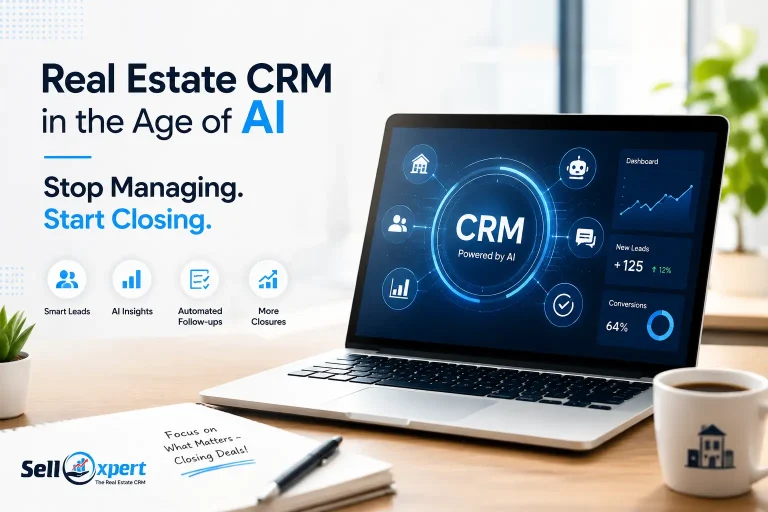
The real estate industry has always been a relationship business. But relationships don’t scale — at least, they didn’t used to.
Today, the conversation around CRM has changed completely. It’s no longer about who has the most organized pipeline or the cleanest database. It’s about who has the most intelligent one.
The Old CRM Was a Filing Cabinet
Let’s be honest. Most real estate CRMs were glorified contact lists with reminders stapled on. Agents logged calls manually. Follow-ups got missed. Leads went cold while you were busy closing something else. The tool existed to organize the past, not to shape the future.
That era is over.
What AI Actually Changes
AI doesn’t just automate tasks — it changes the economics of attention.
A top-performing agent today can effectively manage a pipeline three to five times larger than before, not because they’re working harder, but because AI handles the cognitive overhead. Here’s what that looks like in practice:
Lead Scoring That Actually Works – AI models trained on thousands of transactions can now predict buyer intent with uncanny accuracy — flagging which leads are likely to transact in the next 90 days based on behavioral signals: portal visits, search frequency, price range shifts, even time of day of engagement. You stop chasing and start prioritizing.
Hyper-Personalized Outreach at Scale – Sending 200 people the same newsletter is not follow-up. AI-powered CRMs now generate contextual, personalized messages — referencing a client’s specific search behavior, neighborhood preference, or last conversation — automatically. It feels human. Because it’s built from human data.
Predictive Pipeline Management – Instead of reviewing a static list every Monday morning, your CRM surfaces what needs attention right now. A deal that’s been quiet for 11 days. A buyer who just re-engaged after three months of silence. A seller whose listing window is closing. AI doesn’t wait for you to notice — it notices for you.
Voice and Conversation Intelligence – Modern AI can transcribe, summarize, and extract action items from every client call. No more relying on memory or scribbled notes. Every conversation becomes structured data. Every commitment becomes a tracked follow-up.
The Shift From Reactive to Proactive
Traditional CRM made you reactive — you’d log what happened and set a reminder for the next step. AI-native CRM makes you proactive — it tells you what’s about to happen and suggests the right move before the opportunity slips.
This is the real unlock. Not efficiency. Foresight.
What This Means for Brokerages
For teams and brokerages, the implications go beyond individual productivity. AI-powered CRMs can now:
- Identify which agents are at risk of losing a deal — and when to intervene
- Redistribute leads based on real-time agent capacity and performance data
- Surface market-level trends from aggregated pipeline data before they show up in public reports
The brokerage that treats its CRM as a data asset — not just a workflow tool — will compound its advantage over time. Every transaction, every touchpoint, every outcome becomes training data for better decisions next quarter.
The Caveat Nobody Says Out Loud
AI is only as good as the data you put in. A CRM that nobody updates is still useless, regardless of how much intelligence sits on top of it.
The discipline of data hygiene isn’t going away. If anything, it matters more — because now, garbage in doesn’t just give you a messy pipeline. It gives you confidently wrong predictions.
Culture eats technology. The best AI CRM deployed in a team that doesn’t trust or use it will underperform a basic spreadsheet in a team that’s disciplined.
The Bottom Line
Real estate has always rewarded the people who stay closest to their clients. AI doesn’t change that truth — it amplifies it.
The agents and brokerages who win the next decade won’t be those who resist automation. They’ll be the ones who use it to do what no algorithm can: build genuine trust, faster, at scale.
Your CRM used to store your relationships. Now it should grow them.
The question isn’t whether AI belongs in your CRM. It’s whether your CRM is ready for AI — and whether you are.
To get an expert guide, talk to your expert today!